.

Here, gathered in our beloved South Dakota, are a few members of our Williamson / Mattson Clan. Charles and Luella are to be blamed (be kind, they didn't know what they were doing). We're generally a happy bunch and somewhat intelligent (notwithstanding our tenuous grasp on reality). I'm also proud to say that most of us still have our teeth.
Showing posts with label Williamson / Willis. Show all posts

Sunday, August 28, 2016

More On Our 5th Great Grandfather John Nossaman, Revolutionary War Veteran (Williamson Line)

From the Fortress of Solitude
Pleasant Grove

Hello All,
     The posts to the blog are few and far between. I've exhausted most avenues of online research and wait for additional information to appear. The good news is that there is new information on our 5th Great Grandparents on the Williamson line; John and Catherine Nossaman (Nosseman).  This comes from the Find a Grave project's website. 
     We will start with the Relationship Chart for reference:

Relationship Chart
 
5th Great Grandparents 
John Conrad Nosseman
Married Catherine
to
Catherine Nosseman
Married Bennett Willis
to 
Jonathan Willis
Married Anabella Phlegar
to
Margaret Ann Willis.
Married George Matthew Williamson
to
William J. Williamson
Married Effie Helen Victor
to
Vennie, Ima Della, Inez, Lillie Ethel, Josie, Emmett, Walt, Charles, Maurice.
to 
Charles married first Elda Kay Vercellino and second Elsie Jensen
to
US 

The following is the biography of John Nossaman from the Find a Grave Project.

Birth: Jan., 1751, Germany 
Death: 1827 West Virginia, USA
     Family genealogists concur that this is the grave of John Nossaman, Sr., honored by his family and friends w/ old style Roman lettering of his headstone. He was christened Johan Conrad Nasseman, 25 Jan 1751 in Mainz, Germany, the son of Heinrich and Anna Marie (Gretz) Nasseman. At the age of 22 he struck out by himself and emigrated from Germany to America, arriving in Philadelphia on the ship "Sally" on August 23, 1773. Soon after arriving, he Americanized his name to John Nossaman. During a six year indenture he served to pay for the passage, he won his wife, Cathrina, and enlisted in the Lancaster County Pennsylvania Militia. He served in that unit continually during the Revolutionary War, first as a substitute, then as his own man, from 1777 through 1784. He mustered out of the 7th battalion, 5th Company of the Lancaster County Militia in 1784, just a few months after the Treaty of Paris was signed. 
     By 1785, he had purchased 10 acres in Lancaster County. Along with many other German immigrants, he then moved with his wife Cathrina and growing family, likely down the Wilderness Trail, to the Virginia frontier, arriving in Greenbrier County prior to 1789. It was less than a decade after the last of the Indian Wars, although periodic troubles continued through at least 1781. He acquired land on Indian Creek in Greenbrier County, VA in 1789 and farmed several plots in the region, without slave labor. By this time, he had dropped "Conrad" from his name. 
     He bought, farmed and sold various plots on Indian Creek, Rich Creek, and Brush Creek in newly formed Monroe County, and later in life across the New River in Giles County. At his homesteads in Monroe County he raised a family of four daughters and a son, nurturing them to maturity with his spouse Cathrina, and saw them marry well.

      Catherine, b. 1779 PA, m. Bennett Willis in VA 1800, d. 1843, VA (8 children) 
      Elizabeth, b. 1782 PA, m. David Paine in VA 1801 VA, d. 1815, VA (>5 children) 
      John, Jr. b. 1786 PA, m. Abigail Wylie in VA 1809 VA, m. Luresa Meadows, 1821, KY, d. 1849, IN (13 children) 
      Susannah, b. abt 1790, VA, m. William Pennington, Jr. 1808 in VA, d. 1834, KY (11 children) 
      Sidney, b. 1796 VA, m. John Belcher in VA 1816, VA, d. 1850, IN (11 children) 

      The record indicates he was successful as a tobacco farmer, businessman, and family man: he and Cathrina celebrated more than 40 years of marriage together, and they became grandparents of at least 48 grandchildren. There are consistent indications in the record that he was literate, enterprising, entrepreneurial, individualistic, industrious, vigorous in acquiring and defending his property, and respected by his neighbors, the founding settlers of Peterstown. 
     Today his descendants number more than 20,000 across eight generations, with 8000 or more living today, including many with surnames of Pennington, Willis, Paine, Belcher, Sytsma, and many others. He is the patriarch of the Nossaman family name in the United States. 

Sunday, February 8, 2015

Hans Georg Gutekunst. Our 5th Great Grandfather. Leaving Germany. Peril on the Sea. Revolutionary Soldier at Valley Forge. An Honorable Death. Williamson Line

From the Fortress of Solitude
Pleasant Grove

Hello All,
My 5th Great Grandfather, Hans George Goodykoontz (Gutekunst) fought in the Revolutionary War.
Gutekunst in German means being good at one's trade.  He was born in Germany and immigrated to America early in his life.  This blog has other posts on the life of Hans George Goodykoontz so I won't labor you with a retelling of things you may have already read.  The purpose of today's post is to clarify points in his history from a new source.

Let's start with the Relationship Chart.


Relationship Chart
Hans Georg Goodykoontz (Gutekunst) (1732 - 1784)
is your 5th great grandfather
daughter of Hans Georg Goodykoontz (Gutekunst)
daughter of Anna Margaretha Goodykoontz (Gutekunst)
daughter of Arabella Phlegar
son of Margaret Ann Willis
son of William Jonathan Williamson
son of Charles Williamson
To Us.


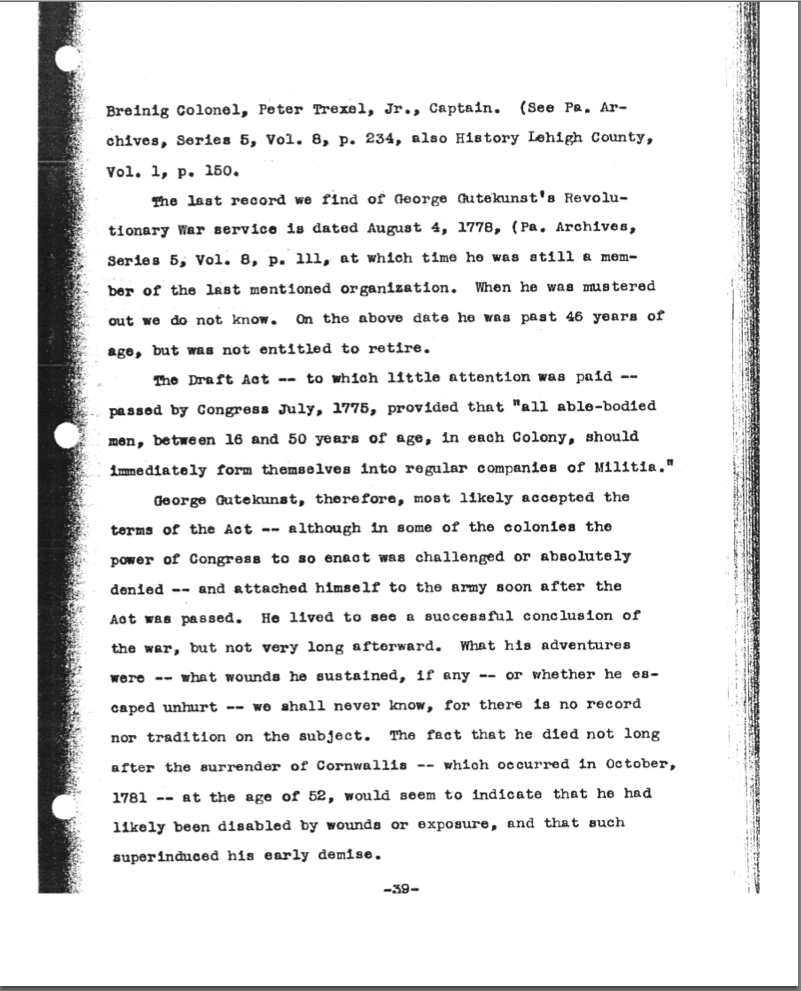
The following information comes from a section of US Congressman Wells Goodykoontz'a "A Historical Sketch of the Goodykoontz Family in Virginia." The manuscript of this book (which was never published) is held by the Virginia Historical Society.

We start with his journey from Germany to America.


George Gutekunst as a Soldier of the Revolution


From the same manuscript we have this information on the death of Hans Georg Gutekunst.


The following Information covers the Battle of Germantown, in which our ancestor fought.
The Battle of Germantown
Battle of Germantown - Date:
Fought less than a month after the British victory at the Battle of the Brandywine (September 11), the Battle of Germantown took place on October 4, 1777, outside the city of Philadelphia.
Battle of Germantown - Background:
Following their victory at the Battle of Brandywine on September 11, 1777, British forces under General William Howe captured the colonial capital of Philadelphia. Unable to prevent this, General George Washington moved the 11,000-man Continental Army to a position along Perkiomen Creek between Pennypacker's Mills and Trappe, PA, approximately 30 miles northwest of the city. Concerned about the American army, Howe left a garrison of 3,000 men in Philadelphia and moved with 9,000 to Germantown. Five miles from the city, Germantown provided the British with a position to block the approaches to the city.
Battle of Germantown - Washington's Plan:
Alerted to Howe's movement, Washington saw an opportunity to strike a blow against the British while he had numerical superiority. Meeting with his officers, Washington developed a complicated attack plan which called for four columns to hit the British simultaneously. If the assault proceeded as planned, it would lead to the British being caught in a double envelopment. At Germantown, Howe formed his main defensive line along the Schoolhouse and Church Lanes with Hessian Lieutenant General Wilhelm von Knyphausen commanding the left and Major General James Grant leading the right.
On the evening of October 3, Washington's four columns moved out. The plan called for Major General Nathanael Greene to lead a strong column against the British right, while Washington led a force down the main Germantown Road. These attacks were to be supported by columns of militia which were to strike the British flanks. All of the American forces were to be in position “precisely at 5 o’clock with charged bayonets and without firing.” As at Trenton the previous December, it was Washington's goal to take the British by surprise.
Marching through the darkness, communications quickly broke down between the American columns and two were behind schedule. In the center, Washington's men arrived as scheduled, but hesitated as there was no word from the other columns. This was largely due to the fact that Greene's men and the militia, led by General William Smallwood, had become lost in the darkness and heavy morning fog. Believing that Greene was in position, Washington ordered the attack to commence. Led by Major General John Sullivan's division, Washington's men moved to engage British pickets in the hamlet of Mount Airy.Battle of Germantown - Problems Arise:
Battle of Germantown - American Advance:
In heavy fighting, Sullivan's men forced the British to retreat back towards Germantown. Falling back, six companies (120 men) of the 40th Foot, under Colonel Thomas Musgrave, fortified the stone home of Benjamin Chew, Cliveden, and prepared to make a stand. Fully deploying his men, with Sullivan's division on the right and Brigadier General Anthony Wayne's on the left, Washington bypassed Cliveden and pushed on through the fog towards Germantown. Around this time, the militia column assigned to attack the British left, arrived and briefly engaged von Knyphausen's men before withdrawing.
Reaching the Cliveden with his staff, Washington was convinced by Brigadier General Henry Knox that such a strongpoint could not be left in their rear. As a result, Brigadier General William Maxwell's reserve brigade was brought up to storm the house. Supported by Knox's artillery, Maxwell's men made several futile assaults against Musgrave's position. At the front, Sullivan and Wayne's men were exerting heavy pressure on the British center when Greene's men finally arrived on the field.
Battle of Germantown - The British Recover:
After pushing British pickets out of Luken's Mill, Greene advanced with Major General Adam Stephen's division on the right, his own division in the center, and Brigadier General Alexander McDougall's brigade on the left. Moving through the fog, Greene's men began to roll up the British right. In the fog, and perhaps because he was intoxicated, Stephen and his men erred and veered right, encountering Wayne's flank and rear. Confused in the fog, and thinking that they had found the British, Stephen's men opened fire. Wayne's men, who were in the midst of an attack, turned and returned fire. Having been attacked from the rear and hearing the sound of Maxwell's assault on Cliveden, Wayne's men began to fall back believing they were about to be cut off. With Wayne's men retreating, Sullivan was forced to withdraw as well.
Along Greene's line of advance, his men were making good progress, but soon became unsupported as McDougall's men wandered away to the left. This opened Greene's flank to attacks from the Queen's Rangers. Despite this, the 9th Virginia managed to make it to Market Square in the center of Germantown. Hearing the cheers of the Virginians through the fog, the British quickly counterattacked and captured most of the regiment. This success, coupled with the arrival of reinforcements from Philadelphia led by Major General Lord Charles Cornwallis led to a general counterattack all along the line. Learning that Sullivan had retreated, Greene ordered his men to disengage retreat ending the battle.

Battle of Germantown - Aftermath

The defeat at Germantown cost Washington 1,073 killed, wounded, and captured. British losses were lighter and numbered 521 killed and wounded. The loss ended American hopes of recapturing Philadelphia and forced Washington to fall back and regroup. In the wake of the Philadelphia Campaign, Washington and the army went into winter quarters at Valley Forge. Though beaten at Germantown, American fortunes changed later that month with the key victory at the Battle of Saratoga.

Tuesday, February 14, 2012

A Pirate in the Williamson Line.

Henry Strangeways

From the Fortress of Solitude
Pleasant Grove

Hello Williamsons,
What is Valentines Day without a good pirate story? Tonight we learn about our 12th Great Grandfather Henry Strangeways - its "Yo ho Yo ho A Pirate's Life for me". We begin with the Relationship Chart.

Sir Henry Strangwayes (1506 - 1544)
is your 12th great grandfather
Son of Sir Henry
Son of Giles
Daughter of Sir John
Son of Grace
Son of Edmund
Daughter of Thomas
Son of Rebecca
Son of Cuthbert
Son of Cuthbert
Son of Matthew

William Jonathan Williamson, son of George Matthew (1858-1934)
married Effie Helen Victor (1867-1944)

to
their children

Ima Della, Vinnie, Inez, Lillie Ethel, Josie Elvery, Emmett, Walter, Charles, Maurice
to
Us


Henry Strangways (died in 1562) also sometimes known as Stranwish, was an English Gentleman Pirate who attacked Spanish and other shipping. He was repeatedly imprisoned, and pardoned by highly-placed friends during his approximately eight year piratical career from about 1552 to 1560.

Strangways began his life as a pirate in 1552 plying the Irish Sea for plunder. There he joined forces with the Cornish Killigrews. His achievements were such that two men of war were prepared at Portsmouth to apprehend Strangways. He next appears in the historical record in 1555 imprisoned in the Tower of London. However nothing came of it and it is probable he had highly placed friends helping him out. In 1559 he was condemned to death after being arrested with 80 of his men, but he managed to avoid the sentence just before execution.

That same year n 1559 he was recorded as wanting to "steal an island" from the King of Spain. However, piracy seems to have taken precedence, he attacked not a Spanish island but Spanish ships. This is known to us because of an official complaint and request for damages which was made out to Philip II of Spain in which a ship, belonging to Johannes de Bagnes, was plundered by Strangeways.

Stangeways died a free man in 1562, pardoned once again by well placed friends, this time the highest, Queen Elizabeth I. The Royal Pardon after his death, the many releases from jail, and the seemingly complicit co-operation by authorities has suggested to later historians that Strangways reputation is as much a Privateer as a pirate.

Sunday, February 12, 2012

Our Williamson Quaker Roots

From the Fortress of Solitude
Pleasant Grove

Hello Williamsons,
Snow if falling over Utah Valley! From the front window I can see most of Pleasant Grove. American Fork disappears into a wall of white. I don't mean to startle you with the exclamation mark (one should take caution when using strong punctuation on a Sunday), but I wanted to emphasis the fact that this is the second time this winter snow has accumulated on the Fortress' front lawn. We were buried under a mountain of white this time last year. This certainly has been an interesting winter.

Today I wanted to introduce you to the faith of many of our Williamson forefathers. The following list represents just a few in our family line professing Quakerism. Their strong religious beliefs brought them to this country. We are the fortunate beneficiaries of their decision.

10th Great Grandparents, William Brinton and Ann Bagley
9th Great Grandparents Francis and Alice Fincher
8th Great Grandparents, Francis and Grace Standfield
8th Great Grandparents, Henry Willis and Mary Pease
6th Great Grandparents, Joseph and Rebecca Bennett

Many in the above list were persecuted for their Quaker beliefs. They endured steadfastly with a determination to raise their children in a community which tolerated religious freedom. I admire them most of all.

I believe to truly appreciate our family's strong religious history we should know something about their beliefs. For that reason I'd like to introduce you to Quakerism 101. Please take a moment to familiarise yourself with our grandparent's beliefs and practices.

Simply,
Victor


American Quaker History
(The Religious Society of Friends)
A Primer
In 1675, another large group of immigrants left England for the New World. They were mainly from the Midlands region of England, and most were members of the Society of Friends, called the Quakers. From 1675 to 1725, over 23,000 of them settled what would become Pennsylvania, Delaware, and Eastern New Jersey.

Religious Beliefs

The Quakers were members of a faith called the Society of Friends. Their religious beliefs were very different from the Anglicans, Pilgrims, and Puritans. Their faith was centered on a "God of Love and Light." They believed that each person was capable of being saved by "the inner light." For them, this light was represented in Jesus.

The Quakers didn’' believe in the authority of clergy. They also didn't believe that God should be worshiped in churches. Instead, they created an organization based on the equality of individuals. They held meetings in meeting houses rather than religious services in churches.

The Quakers believed that war was wrong. They refused to support a military, unlike many other colonists. Also, they were one of the first American colonial groups to condemn slavery. They believed in the natural equality of all people under God.

Like the Puritans, the Quakers had suffered from persecution because of their faith, in both England and America. The ruling Anglicans in England imprisoned Quakers because they didn't believe in paying taxes. In Virginia, they banished them. The Puritans of Massachusetts banished Quakers, and, in some cases, burned them as witches.

The Quakers themselves developed a different approach to those who didn't share their beliefs. In their own colony in the New World, they promoted religious freedom. People in Quaker settlements were allowed to worship according to their own Christian beliefs. However, Quakers didn't allow people who did not believe in God to settle in their colonies.

Other Immigrants

In this spirit, the Quakers welcomed several different immigrant groups to share their settlements. William Penn, founder of the colony, actually recruited many of these people from their native lands. There were German, French, Dutch, Swedish, and Danish settlers in the Delaware Valley. Some of them were Quakers, and some were from other religious backgrounds. The Germans especially found the area welcoming. In fact, the term "Pennsylvania Dutch" refers to the German word for "German": "Deutsche."

Who Were the Quakers?

Most of the Quaker settlers had come from the northern Midlands area of England. There were also some that immigrated from Ireland and Wales. About half of them came as family groups.

Their economic and social backgrounds were very different from the Pilgrims, Puritans, and Anglicans. Most of them were poor to middle class. Very few came from the upper classes. Most made their living as craftsmen, farmers, and manual laborers.

Although many were poor, they found the means to come to the New World. Some had been given the money for their passage by Quakers in England. That means they came to this country without a large debt to pay off.

They brought their manner of speech from the Midlands, too. The colonial Quakers used the forms of speech "thee" and "thou" for "you," as did their English relatives. This form of speech is still used among the Amish people of Pennsylvania. They are descendants of the early German settlers.

The Delaware Valley

The Delaware River Valley was an area full of promise for the Quaker colonists. The Delaware and the river systems around it were good settings for mills and commercial trading by boat. There were many natural resources in the area, too, with coal, iron, and copper. The fertile soil was good for farming.

William Penn making a treaty with Native Americans in Pennsylvania.
The climate of the area was temperate. This was good for farming, and for the health of the colonists. They did have malaria and yellow fever epidemics, but not to the extent the Virginians did.

The Delaware Indians

The Native American tribes in the Delaware Valley were friendly to the new settlers. They were very different from the warring tribes who had threatened the Jamestown settlers in Virginia. The Lenni Lenape (called the Delaware Indians by the Quakers) did not fight the new colonists. Also, the Quakers bought land from the Delaware; they did not claim it as their own. Founder William Penn learned the language of the tribes so he could communicate with them.

William Penn

William Penn.
William Penn (1644-1718) was one of the most important colonists of the era. He was an English Quaker who received the land that became Pennsylvania from the English king, Charles II. It was in payment of a debt owed Penn's late father. It was Charles II who named the new area "Pennsylvania," for the man who was its most important early leader. Penn developed its laws, society, and commerce, and also oversaw its growth. He established a colony built on the idea of harmony and love among the people.

Their Homes

Most Quakers made their homes of fieldstone, with slate roofs and windows and doors made of wood. They came in two styles. One was a two-story house with rooms on each floor and fireplaces on one side. The other was called a "Four-over-Four" house. This was a two-story house with four large rooms on each floor. They were simply furnished and full of light. The simple lines of this furniture are still popular today. It is the style of Shaker furniture, named after a 19th century religious group related to the Quakers.

An example of a Quaker house,
from Quakerstown, Bucks County, Pennsylvania.

Family Life

As in other colonial cultures, family was the center of life for the Quakers. They thought that the family was the center of love. For them, that love included both the traditional family and the "family" of all members of their faith.

The Quakers encouraged marriage within their community. But they discouraged Quakers from marrying non-Quakers. People who did that were often banished from the community.

Raising children was of great importance to Quaker family life. Their upbringing was a serious responsibility for parents and the whole community. Children were taught to obey their parents. But the Quakers didn't agree with the Puritan's harsh punishment of children. Instead, they used reason to reinforce good behavior. Nor did they agree with the Puritan idea of "sending out." They encouraged their children to stay at home among family. They were very strict in certain areas, however. For example, they didn't allow dancing, which they thought was wicked.

The Quaker idea of equality was part of their understanding of family. Children were considered to be equal to adults in many ways. In the home, children sat at the dinner table with their parents. In the meeting house, children as well as adults preached to the members.

The Quakers' idea of equality extended to women, too. In the 18th century, most cultures and religions considered women inferior to men. But the Quakers celebrated equal roles for women and men, especially in practicing their faith.

Quaker Meetings

The Quakers held meetings several times a week in a meeting house. Like their homes, the Quakers' meeting houses were simple buildings. In them, they held worship services, as well as the community's business meetings. Women and men held separate meetings. They worshiped together, in separate areas.

The Quaker services were very different from other Christian services. They quietly gathered together in the meeting house. Then they each "turned their mind to the light." There was no altar or pulpit. They didn't have a minister to lead them in worship, because they didn't believe it was necessary. They didn't have a set of rituals to follow, either.

A painting showing a Quaker meeting, with a woman preaching.
Often individuals, young and old, male and female, would rise and begin to preach. Their belief in the equality of Friends led them to believe that anyone could be inspired to preach.

Childhood: School

While the Quakers were great believers in the power of reason, they had many different approaches to education. Children were encouraged to learn to read by reading the Bible. But they weren't encouraged to spend years in school, as the children of the Puritans were.

The interior of the Plymouth Quaker Meeting House
in Montgomery County, Pennsylvania, built in 1708.
Still, literacy was encouraged, and about one-half of adult colonists could sign their names. There were laws establishing schools, and requiring that children learn to read and write by the age of 12. Many schools were part of local Quaker meeting houses, and were run by them.

The Quakers favored "natural knowledge," and learning by doing. They also encouraged children to learn a trade. Boys and girls were encouraged to learn, in the classroom and in the world around them.

Their Food

As in so much of their life, the Quakers stressed that food should be simple. Like the Puritans, they didn't believe in indulging their appetites, so feasting was discouraged.

The Quakers liked simple food, prepared simply. They usually boiled their food, and made different kinds of puddings and dumplings. Through boiling, they created a food we still eat today: Philadelphia cream cheese. They made it by boiling cream, then drying it in cloth. They also made foods like apple butter in a similar way.

In keeping with their religious beliefs, the Quakers avoided foods that were created with slave labor. At that time, sugar came from sugar plantations, worked by slaves. Many Quakers refused to buy it. Also, salt was taxed, and the taxes used to pay for the military. The Quakers were pacifists--they did not believe in war--so many did without salt, too.

Their Clothing

The Quakers dressed plainly. They believed that clothing should be as simple as possible, in cut and color. Even hats and hairstyles were discouraged. Most clothes were made of gray homespun fabric. Men wore leather breeches or simple trousers, shirts, and aprons to protect them while working.

Women's clothing was also extremely simple. Their clothing didn't have buttons, pockets, or decorations of any kind. Women wore simple homespun dresses, with aprons and a simple shawl. Their clothing was grey or another dark color. Children dressed like their parents, in very simple clothing.

Games and Sports

The Quakers didn't like sports. They thought they corrupted the natural order of life. They had laws that forbade them. They especially condemned the "blood sports" and gambling favored in Virginia. They believed that killing for sport was evil, and that an animal's life should be taken only to provide food.

The Quakers also condemned ball games enjoyed by the Puritans of New England. But they did believe that exercise was good for people, especially children. They encouraged activities like swimming and ice-skating, which they found "useful." They also liked to garden, which they considered useful, too.

Celebrating Holidays

Like the Puritans, the Quakers didn't believe in celebrating religious holidays. They believed that all days should be devoted to God. They also believed that gaudy displays on Christian holy days was wrong. The Quakers also refused to celebrate old folk holidays, like May Day. Instead, they treated all days equally, dedicating them to hard work, simple living, and faith.

Organization

The Quaker ideals of equality are seen in the way their colony was organized, including the division of land, and the structure of society and government. William Penn was in charge of selling the land to raise money. Then, he oversaw the dividing up of the land into independent family farms. This he did in a manner that land, and the wealth that land brought, would be evenly distributed. This ensured that there would not be a small number of very wealthy landowners.

Most Quakers lived on a family farm, with other Quaker farms nearby. This encouraged neighborhoods. Quakers often helped out their neighbors, including non-Quaker families, in building homes and barns.

The Quakers elected officials, like sheriffs, judges, and peace makers, to enforce laws and keep order in the settlements. The Quakers encouraged political activity among the settlers of all backgrounds. They held elections, and elected an Assembly in Pennsylvania.

The Quakers also believed in a minimal government, because that allowed greater individual freedom. And, significantly, they believed that a person was free to follow one's own conscience. Even those who disagreed with Quaker ideals were allowed that important freedom within their communities. The first law passed in Pennsylvania established freedom of conscience, and of worship to all.

William Penn outlined three major freedoms: (1) the right to one's life, liberty, and estate, (2) the right to representative government, and (3) the right to trial by jury. Also, taxes could not be imposed without the approval of the people.

Slavery: It is important to note the difference among the colonists on the issue of slavery. While many Quakers owned slaves at the founding of the colony, by the late 17th century, colonial Quakers were fighting for its abolition. In 1758, the Philadelphia Quaker Meeting issued the first anti-slavery document in history.

One of the great symbols of freedom in the U.S. is the Liberty Bell. It was created by the Pennsylvania Assembly in 1751 to celebrate the 50th anniversary of William Penn's "Charter of Privileges." That list of laws and rules outlined the goals of the Quaker colony.

The inscription is taken from the Bible. It states, simply and profoundly, the beliefs of the Quakers: "Proclaim liberty throughout all the land unto all the inhabitants thereof." The great bell was rung on July 8, 1776, to celebrate the birth of a new nation. The Quaker ideal of liberty for all would inspire the colonists as they waged war against those who would deny them their liberties.

Saturday, August 6, 2011

Major General Abraham Wood. Williamson Line

From the Fortress of Solitude
Pleasant Grove

Hello Williamsons,
I'm enjoying the extra time I have to add to a few more names to our family history. In our virtual gathering today we are going to talk about our 8th Great Grandparents Major General Abraham Wood and Margaret Llewellyn. This is a long read but well worth your time, especially the section on the great sea battle he witnessed as a young 10 year old crossing the Atlantic.

Remember, with 100% certainty we know the Williamson line back to our 3rd Great Grandparents Matthew Williamson and Selina Jeffries. From that point on that certainty level drops to 90%. It is my firm belief that Matthew Williamson is a descendant of Cuthbert Williamson and Elizabeth Allen (see relationship chart below). I'm not 100% certain that relationship goes through Cuthbert Williamson Junior and Susanna White.


Relationship Chart
8th Great Grandfather Major General Abraham Wood and Margaret Llewellyn
to
Mary Wood and Thomas Chamberlayne
to
Rebecca Chamberlayne and John Williamson
to
Cuthbert Williamson and Elizabeth Allen
to
Cuthbert Williamson and Susanna White
to
Matthew Williamson and Selina Dandridge Jeffries
to
George Matthew Williamson and Margaret Willis
to
William Jonathan Williamson and Effie Helen Victor
to
Vennie, Ima, Inez, Lille, Josie, Emmett, Walt, Charles and Maurice
to
US

How Abraham might have looked on the sea crossing. Ten years old
crossing without family, coming to Jamestown as an indentured servant.


In 1620 Thomas Osborne paid the fare for 10-year-old Abraham Wood (our 8th Great Grandfather) to come to Virginia on the ship Margaret and John, commanded by Capt. Anthony Chester. On March 14, 1620 the ship was attached by two Spanish war ships. Although they mortally wounded Dr. Lewis Bohun, a Virginia surgeon, Abraham and the ship escaped unhurt. Ten year old Abraham came to Jamestown, American as an indentured servant to Capt. Samuel Matthews.

An Account of the Sea Battle our Great Grandfather Survived in March 1620.
The Spaniards deeply resented the settlement of the English on the North American continent, and would, if they had dared, have made an attempt to wipe out the colony at Jamestown. They, however, kept a constant lookout for the vessels of the Virginia adventurers. The sea fight of the Margaret and John caused much excitement in England, and the English were very proud of the exploits of the ship, which was small and not well provided. In the latter part of March 1621 (1620, O.S.) this vessel had a severe battle with two Spanish men-of-war in the West Indies, in which she was fortunate enough to come out the victor. Two accounts were published. One is given below:

VOYAGE OF ANTHONY CHESTER on the Margaret and John. To Virginia in the year 1620, as narrated by a distinguished passenger; translated into Dutch and published by Peter Vander Aa, bookseller at Leyden, in 1707.

In the beginning of February 1620 I left England in the ship Margaret & John, our ship was of 160 ton burden, our Captain was Anthony Chester a brave seaman. Besides the crew we had on board a good many passengers of whom I was one, our ship carried 8 cannon with a valconet, our
destination was Virginia where we hoped to transact some profitable business. About the 14th of March we came in about 20 miles off Mettalina; the next day we passed Dominica and neared Guadaloupe where we intended to take in fresh water. Nearing this place we observed two vessels lying at anchor which we took to be Hollanders, not only because the ships were built after the model of that nation, but more so because the Admiral had the Dutch flag flying from the mizzenmast.

Expecting no harm we kept straight on &
anchored in their immediate vicinity; but so as not to be taken by surprise we sent some sailors in a boat towards the Admiral's ship to reconnoitre, who returned in a very short time with the report that they were two Spanish men of war. Notwithstanding this we sent the boat out a second time to make a more thorough investigation while we commenced busying ourselves to make things ready in case it should come to a fight. But our ship was so full of household goods that we could not place our cannon as we wanted to, and so we had to make out the best we could. Upon our boat reaching the Vice Admiral's ship our men inquired from whence the ship, but instead of receiving a polite reply the Spaniards demanded their surrender which of course our men declined and rowed back to our ship as rapidly as possible.

Meanwhile several shots were fired at
them striking and breaking some of their oars, but not a man of them was hurt. When within about a musket shot frm our ship, there were fired at from a big cannon, and as soon as our men were on board of our ship, the Spaniards hoisted sail preparatory to attack us. We on our part anticipated a bloody encounter and were much troubled by our inability to properly place our guns for reason mentioned above. The Spanish Admiral took down the Dutch flag and hoisted the Spanish colors weighed anchor and sailed towards us, but before firing upon us they spoke us enguiring what nationality we were, we replied we were English and had no intention of harming them unless we were forced to do so and that it was our desire to proceed peacefully on ourvoyage. Hereupon, the Spaniard demanded that we take down our mainsail which according to him was required by the rights of the King of Spain and marine usage, whereupon our Captain replied that he could not subject himself to any such rights nor did he intend to harm the subjects of the King of Spain.

While friendly relations existed between ther respective sovereigns
he wished the same to exist between their subjects. After exchanging a few more words, our Captain went down in the cabin, tired of listening any longer to the unjust demands of this Spaniard, but at the request of the Admiral our Captain came again on deck and was ordered to come on board the Admiral's ship to show his papers, but this our Captain refused to do saying if they wished to see them they could come on board his ship and he would show them his papers. But what happens? Instead of answering by word of mouth, they saluted us with two pieces of cannon and a hail storm of musket balls, drew their swords, threatened to cut us to pieces, and calling us dogs, grappled us and thought they had subdued us already, when, at a sign previously agreed upon, our men sprang forward with their muskets and received them so well, supported by our 4 pieces of cannon, that they had to retreat. It was not long though before they returned attacking us with a loud noise, grappled us again, and began to come on board our ship but our men led by our brave and courageous Captain received them so well with their muskets, spears, and grappling axes that we drove them off a second time sending many of them to a watery grave. This, however, did not satisfy the Spaniard, they attacked and grappled us a third time and during the fierce hand to hand fight, which now ensued, we had the good luck to shoot their Admiral down upon which they raised such a hue and cry that it astonished all of us, and they immediately took to flight leaving us the victory.

In this fierce and bloody encounter we, for reasons mentioned before, could
not bring but 4 of our 8 cannon into use, but these were handled so rapidly and skillfully that several times the Spaniard would have gotten away from us but for their ship being lashed to ours until finally one of our men, with orders from our Captain, cut the ropes with his grappling axe upon which they immediately took flight giving us several volleys from their big and small guns as they retreated. The Vice Admiral, seeing we did not pursue his Admiral, acted as if he wanted to fight us again, but we did not mind him much, and set to work to face them both if they were so inclined. But the admiral's ship held off and we now attacked the Vice Admiral so furiously that we disabled his ship to such an extent that the whole crew had to take to shore to save themselves from a watery grave.

The night following this battle, all on board our ship, passengers as well as
crew, were busy filling cartridges, cleaning cannons and muskets repairing damages etc. so as to be ready in case the Spaniard should feel inclinced to attack us again, and by dawn of day it looked as if we had not been working all night in vain, the Spaniards seemingly preparing to attack us again. However, after looking at each other for about two hours with frowning faces, the Spaniard hoisted sail and took their course towards the nearest island, their movements being such that it was plain that they must have had a good many dead and wounded.

On our side we had 8 dead,* and of the 16 wounded 2 died
afterwards; how many of the Spaniards were killed we never knew but certain it is that during the encounters we saw many of them fall and not a few find their grave in the water which was actually red with their blood. Among the dead was Dr. Lawrence Bohun, who was educated "among the most learned surgeons and physitians in the Netherlands." He came to Virginia with Lord Delaware in 1610. December 13, 1620, being in London, he was appointed by the London Company physician general to the colony; and soon after he sailed for Virginia on the Margaret and John with Captain Anthony Chester. During the battle Dr. Bohun received a mortal wound. Capt. Chester embraced him and exclaimed, "Oh! Dr. Bohun, what a disaster is this." The noble Doctor replied, "Fight it out, brave man, the cause is good, and Lord receive my soul." (Brown's Genesis U. S., II., p. 830.) The Amiral's ship was also of 300 ton burden and carried 16 big guns with a correspondingly ample supply of men and ammunition; on the other hand ours was a small ship, as stated before, with 8 big guns of which we could only use 4, notwithstanding which we were so fortunate as to come out victorious. We now proceeded on our voyage and landed without further accidents in Virginia. Soon thereafter Captain Chester obtained a return cargo and set sail again for England.


Abraham rose rapidly to public prominence. He was a justice of Charles City County. He was a member of the House of Burgesses (1644-46, 1652, 1654-56) and a member of the Council of Virginia (1657-80). In 1646 they made him captain of Fort Henry, at the site of today’s Petersburg, and by 1658 he was colonel of the militia of Charles City and Henrico counties. The land at Fort Henry, and all the houses, boats, and ammunition there were granted to Capt. Wood for keeping a garrison there for three years to defend the Colony. In 1671 he was one of four major generals commanding the military establishment of Virginia.


A Phamplet Written and Published by Abraham Wood

In 1671 Abraham sent out expeditions westward to explore the country and sent the first expedition known to have crossed the Appalachian Mountains led by Thomas Batte and others. The men of this expedition crossed the Allegheny Mountains 45 years before the expedition of Governor Spotswood in 1716. In 1680 Wood negotiated a treaty with the Indians.
in 1671, Batts and Fallam

Fort Henry was built in 1646 to mark the legal frontier between the white settlers and the Native Americans, and was near the Appomattoc Indian tribe with whom Abraham Wood traded. It was the only point in Virginia at which Indians could be authorized to cross eastward into white territory, or whites westward into Indian territory, from 1646 until around 1691. This circumstance gave Wood, who commanded the fort and privately owned the adjoining lands, a considerable advantage over his competitors in the "Indian trade".

Several exploration parties were dispatched from Fort Henry by Wood during these years, including one undertaken by Wood himself in 1650, which explored the upper reaches of the James River and Roanoke River.

The first English expeditions to reach the southern Appalachian Mountains were also sent out by Wood. In 1671, explorers Thomas Batts (Batte) and Robert Fallam reached the New River Valley and the New River. The New River was named Wood's River after Abraham Wood, although in time it became better known as the New River. Batts and Fallam are generally credited with being the first Europeans to enter within the present-day borders of West Virginia.

In 1673 Wood sent his friend James Needham and his indentured servant Gabriel Arthur on an expedition to find an outlet to the Pacific Ocean. Shortly after their departure Needham and Arthur encountered a group of Tomahitan Indians, who offered to conduct the men to their indian village across the mountains. After reaching the Tomahitan village Needham returned to Fort Henry to report to Wood. While en route back to the Tomahitan village Needham was killed by a member of the trading party with whom he was traveling. Shortly thereafter, Arthur was almost killed by a mob in the Tomahitan settlement, but was saved and then adopted by the village's chief. Arthur lived with the Tomahitans for almost a year, accompanying them on war and trading expeditions as far south as Spanish Florida and as far north as the Ohio River.

Other accomplishments of Abraham Wood:

  • Served as Justice of Charles City.
  • Commanding officer of the "trained bands" of Charles City and Henrico.
  • Member of the House of Burgesses from Henrico 1644-1646 and from Charles City 1652-1656.
  • With Edward Bland, Sacheverell Brewster and Elias Pennant, he undertook in 1650 a voyage of discovery along the Chowan and Nottaway Rivers, which was documented by Bland in "The Discovery of New Brittaine."Source: Extracted from "Adventurers of Puse and Person, page 362-363
Read a letter written by our 8th Great Grandfather:

Sunday, July 24, 2011

More on our 5th Great Grandparents and the Revolutionary War (Williamson Line)


From the Fortress of Solitude
Pleasant Grove

Hello All,

The annual Williamson Family Picnic is underway at Spearfish Park in South Dakota. I was unable to attend. A conflagration of events spewed from Fate's imagination kept me here in Pleasant Grove. My parents Charles and Luella, my sister Jilane (and two of her daughters) my brother Jon (and his son) and my sister Lisa (with her husband and two of her children) are attending along with other Williamsons from far and wide.

The last large family gathering was held three or four years ago. Perhaps it is time for another 'official' reunion. I suggest this one be an entire weekend affair with various events scheduled around the Spearfish / Deadwood area so family members can get to know each other. There is also the suggestion of having a large family gathering here in Utah. There are two branches of the Williamson families living one hour apart in northern Utah; Daniel and Lisa in Park City and several of us living in Utah County. Salt Lake City is a rather inexpensive airport to fly into and of course Utah is at the crossroads of the west - about a one day's drive for anyone in the multi-state region. Regardless of the location, perhaps it is time for another gathering.

Today I have more information on our 5th Great Grandparents John and Catherine Nosseman.
They immigrated to the American Colonies from Germany, thus filling out more of our German ancestral tree. John fought in the Revolutionary War, and according to the information found today may have deserted because he was taking the place of someone else.

We begin with the Relationship Chart: (remember, the full family tree can be found by clicking on the family tree near the top of the blog's right side bar).

5th Great Grandparents
John Conrad Nosseman
Married
Catherine
to
Catherine Nosseman
Married Bennett Willis

to

Jonathan Willis
Married Anabella Phlegar
to
Margaret Ann Willis.
Married George Matthew Williamson
to
William J. Williamson
Married Effie Helen Victor
to
Vennie, Ima Della, Inez, Lillie Ethel, Josie, Emmett, Walt, Charles, Maurice.
to
US

John Conrad Nossaman was born about 1750 in Hesse, Cassel , Germany and settled in Pennsylvania. He came from the Port of Rotterdam in the Netherlands on the ship Sally and took the Oath of Abjuration (an oath asserting the right of the present royal family to the crown of England, and expressly abjuring allegiance to the descendants of Charles Edward Stuart, the Jacobite Pretender).

He ( Johan Conrad Nasemann ) is listed as arriving at the Port of Philadelphia, Pennsylvania August 23, 1773. On September 15, 1773 he was indentured as a servant for a period of 6 years to Job Cose and his assign for the amount of L 32.6.6. Job Cose is reported to live in Waterford Township, Glocester, West Jersey . If he served his full term of this indenture he became a free man on or about August 23, 1779. Indenturing was a way of paying for passage.

John Conrad Nossaman (Yon Conrad Noseman) was enlisted as a substitute in Captain Charles Wilson Peale's company o f the Fourth class, Philadelphia Militia in the service of the United States commanded by Lieutenant Colonel Will to fight in the Revolutionary War. It is likely that he was forced to take the place of his owner or one of his owner 's friends. Of the 55 privates who were enrolled in Capt. Peale's Company at this time, no fewer than 30 were listed as having "deserted" or being "absent without leave. " Johan Conrad Nossaman was listed as having deserted. Approximately 1 in 5 of the enrolled privates on the muster roll were "substitutes" for others.

There is a listing for the birth of Catherine born August 1 9, 1779 as a child of J. Conr. Naseman and Cathrina in Lebanon County, Pennsylvania. Cathrina (Catherina) married Bennett H. Willis November 13, 1800 in Monroe County, Virginia. She married Peter Sickman April 5, 1819 in Franklin County, Virginia.

In 1780? John Nousman was listed on the return of Capt. Noah "Keasy," as a member of the 7th Class of the 5th Company of the 7th Battalion of the Lancaster County Militia. The Muster rolls show on October 28, 1781, "John Naseman" commenced a "touer of Duty" at Lancaster as a private on the Muster Roll of Capt. Robert McKey.

There is a recording of a birth of Elizabeth Nasemann born March 10, 1 782 to Conrad and Cathar. Elizabeth Naseman was christened April 1, 1782 at the Manheim, Zion Evangelical Lutheran Church, Lancaster Pennsylvania. Father was Conrad Nasemann and mother was Cather. She married David Pane April 6, 1801 in Monroe County, Virginia (now West Virginia).

On April 15, 1782 "John Nousman" was listed as a white male inhabitant between the ages of 18 and 53 residing in the district of Capt. Noah "Ceasey". This return was divided into eight classes and "John Nousman" was a member of the seventh class, together with sixteen other men. "John Nousman" was listed in the 1783 and 1784 returns for the fifth company of the seventh class of the Seventh Battalion of the Lancaster County Militia. The vast majority of the names appear to be German.

John Nossaman (Nosman) purchased 216 acres from Francis McNutt in Greenbrier County, Virginia (now Monroe County, West Virginia) in 1789 at a price of 5 shillings.

John Noseman, Sr. sold land to John Noseman, Jr. on July 1 , 1806 in Monroe County for a consideration of the sum of fifty pounds current money of Virginia. John Noseman, Sr. signed this deed whereas John Noseman, Jr. signed with an X with his signature witnessed. This would indicatt hat John Noseman, Jr. could not write which may have an impact of census records in the future.

In the 1810 Census of Monroe County, Virginia, John Nosseman is listed as the head of a household with three individuals a male aged 45 years and upwards and a female aged 45 years and upwards and a female age d 26 years but under 45 years. Several of the individuals believed to be children of John and Katrina Nossaman are in close proximity to them in the 1810 census.

It is suggested that John Conrad died in Giles County, Virginia ( now West Virginia) abt. 1820 but after the 1820 census period. This assumption will need confirmation at a later date.